Rules and ethics
Part of Are food influencer gifting rules different in the UK?
Are food influencer gifting rules different in the UK?
UK food influencer gifting rules: how ASA and CMA disclosure duties apply to gifted meals, snacks and restaurant visits, plus labelling steps for brands.
What to take away
- Gifted food and drink are treated as ads when a brand controls the gift and the creator posts about it. The UK's Advertising Codes apply.
- Disclosure must be clear, prominent and early. A tag like #gifted is not enough on its own if the commercial intent is hidden.
- The Competition and Markets Authority can act on misleading endorsements under consumer protection law, so the risk is not only an ASA ruling.
- Restaurants and food brands should keep a written record of what was sent, what was asked for and when the creator published.
- Tax and VAT treatment can follow the gift. Treat free meals or products as a business cost, not a personal perk.
The short answer
UK gifting rules are not a separate code. They are the same advertising and consumer rules applied to free items. If a food brand sends a meal, snack box or product with an expectation of coverage, the creator's post is likely an ad. That means it must be identifiable as advertising.
The ASA's CAP Code covers non-broadcast ads, including social media. The CMA's guidance on endorsements sits alongside it.
Where the ASA rules bite
The ASA asks whether the brand controlled the content. A free product alone is not control. But a brief, a deadline, a hashtag request or an approval step usually is.
Gifted food labelling scenarios
Scenario
- Free meal, no brief
- Usually no
- Free meal, post expected
- Yes
- Paid meal plus free extras
- Yes
- Unpaid review of bought meal
- No
Likely ad?
- Free meal, no brief
- No
- Free meal, post expected
- Ad
- Paid meal plus free extras
- Ad
- Unpaid review of bought meal
- No
Label
- Free meal, no brief
- Free meal, post expected
- Paid meal plus free extras
- Unpaid review of bought meal
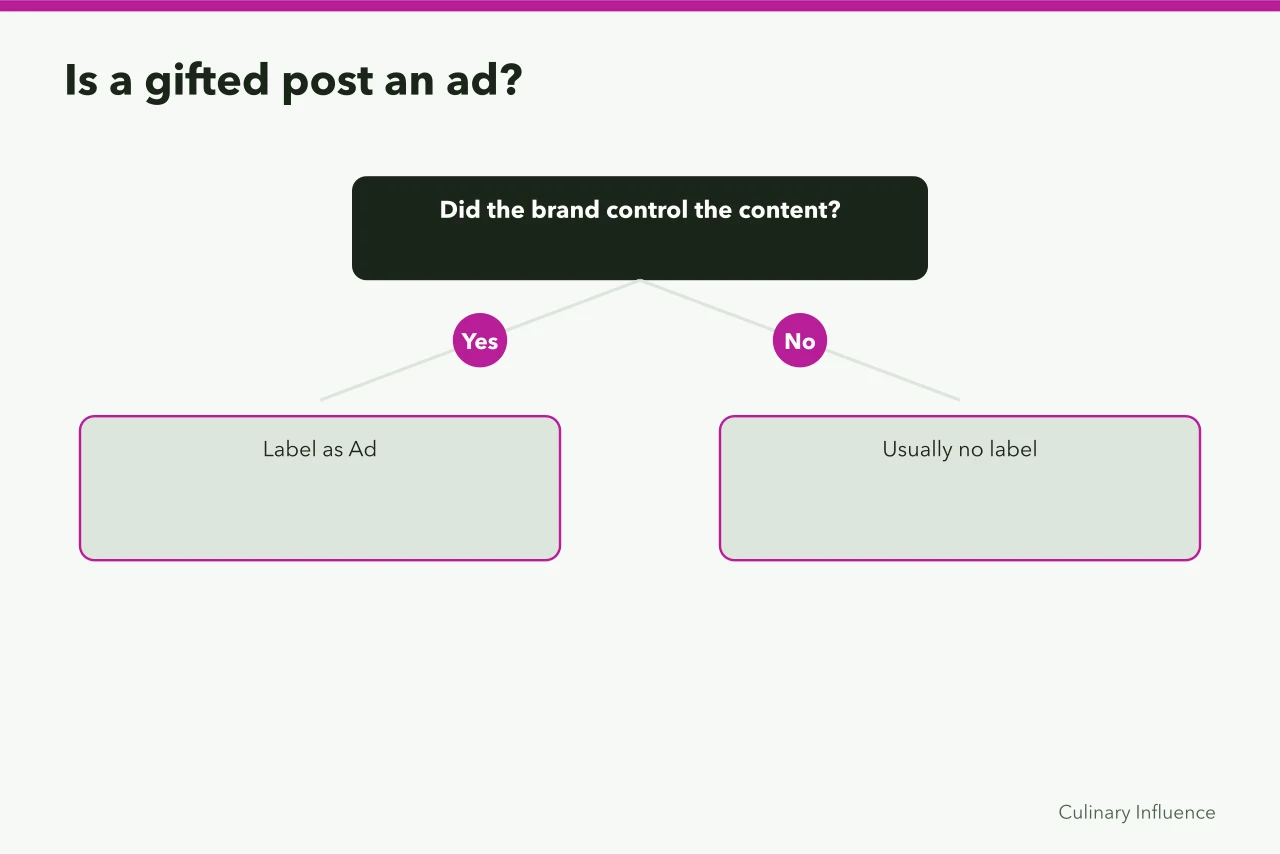
For gifted food, the label must be obvious before the audience engages. 'Thanks to [brand]' can be vague. 'Ad' or 'Advertisement' is clearer. 'Gifted' can work if the post also makes clear that the brand had a say.
The CAP Code's non-broadcast section sets the recognition rules. The Non-broadcast Code explains that marketing communications must be obviously identifiable. That applies to a gifted restaurant tasting or a box of snacks.
The ASA's wider advertising codes also cover food and drink claims. A creator who says a gifted snack is healthy may need evidence, not just a label.
Brand asked for a post?
- Free meal, no brief
- No
- Free meal, post expected
- Yes
- Paid meal plus free extras
- Yes
- Unpaid review of a bought meal
- No
Likely ad?
- Free meal, no brief
- Usually no
- Free meal, post expected
- Yes
- Paid meal plus free extras
- Yes
- Unpaid review of a bought meal
- No
Label
- Free meal, no brief
- No
- Free meal, post expected
- Ad
- Paid meal plus free extras
- Ad
- Unpaid review of a bought meal
- No
What the CMA adds
The CMA can treat a hidden endorsement as a misleading commercial practice. That can matter when a food brand uses a creator to push a health claim or a discount. The CMA's role is set out on its Competition and Markets Authority page.
The CMA has taken action on online endorsements before. Food brands should not assume a small gift falls outside the rules. A free product can still influence a buying decision.
A worked example: gifted meal
- A restaurant invites a food creator to a tasting. The restaurant asks for one Instagram Reel and two Stories. The meal is worth £45. The creator is not paid a fee.
- The value of the gift is £45, but the commercial relationship is the key. The restaurant set the content request, so the Reel and Stories are ads.
- The creator labels the first frame of the Reel 'Ad' and adds 'gifted meal' in the caption. The Stories carry a 'Paid partnership' tag where available.
- The restaurant keeps the invitation, the brief and the published links. It also notes the £45 cost in its marketing records.
- If the creator later posts an unbriefed photo of the same meal, that separate post may not need a label. Context matters each time.
How to stay compliant
- Write a simple agreement before sending anything.
- State what the brand expectscoverage, timing and approval.
- Tell the creator to label the ad at the start.
- Check the label on every platform.
- Keep records for at least two years.
Restaurants that send PR packages should define the gift value and the expected posts. Our guide to restaurant PR packages for influencers covers what to include and what to ask for.
Common questions
Does a free meal count as an ad?
Yes, if the brand gave it in return for coverage or with a reasonable expectation of a post. The label should say 'Ad' or 'Advertisement' in a place the audience sees before engaging.
Do I need a written agreement for a gifted post?
No law says every gift needs a contract, but a short agreement helps. It should record the gift value, the requested content and the disclosure wording.
What if the creator is not paid?
Payment is not the test. Control and commercial intent are. An unpaid creator can still publish an ad if the brand supplied the food for coverage.
How long must the ad label stay visible?
The label must stay visible for as long as the post is live. Do not bury it in a comment or a hashtag pile. Put it in the first frame or the first line. For creator fee benchmarks, see food influencer rates UK.