Strategy
Part of When to set the objective before briefing any food creator
Nine food creator partnerships strategy mistakes to stop making
Nine food creator partnerships strategy mistakes, with the inclusion criteria and UK advertising rules that should shape your brief before you sign anything.
What to take away
- The mistake most teams make first is agreeing reach and aesthetics before anyone writes down what the partnership is for, which leaves nothing to judge it against later.
- Most of the nine mistakes below are paperwork failures rather than creative ones, so they are cheap to fix early and expensive to fix later.
- Apply the inclusion criteria below before copying any tactic from another operator: your venue type, your trading pattern and the rules that bind you.
- Health and Safety Executive guidance for catering is a floor, not an extra, because creators filming in a working kitchen change the risk picture.
How to use this list
The inclusion criteria to apply
This list covers mistakes made by UK restaurant, cafe, pub and food retail operators working with food creators of any size. It leaves out brand-funded television, paid display advertising and pure affiliate schemes.
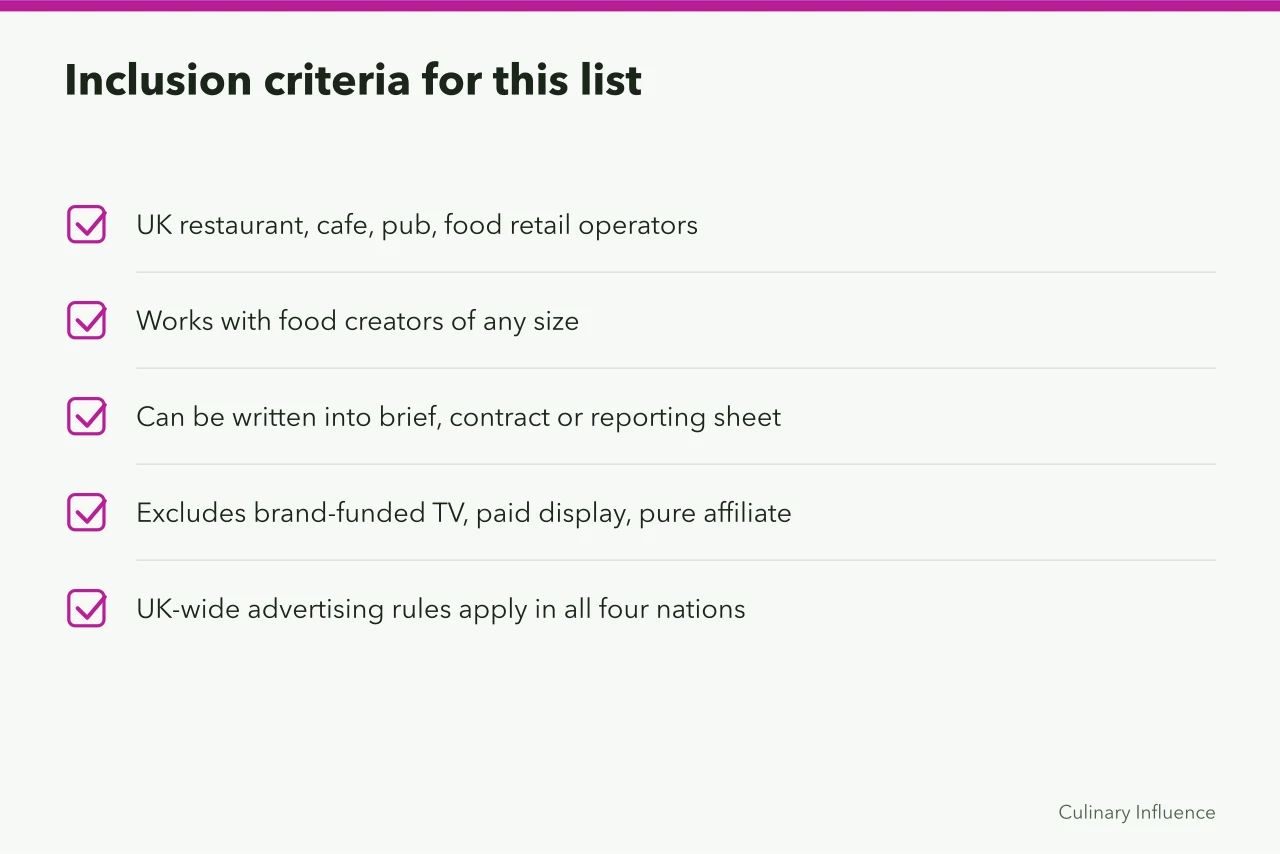
A tactic earns a place only if an operator can write it into a brief, a contract or a reporting sheet. Anything resting on one creator's personal style is out of scope.
Advertising rules are set for the whole United Kingdom, so a claim that fails in one nation fails in all four.
Why the order is not a ranking
There is no score, cost or recommended supplier here. Nothing has been tested, reviewed or shortlisted, and no product is endorsed.
Where a number appears it is sourced with its date or labelled as an illustrative example, such as a team paying £400 a month for a retainer.
Four terms are worth fixing before you read on:
Four terms to fix before reading
- Briefwritten instructions given to a creator
- Disclosurelabel telling audience a post is advertising
- Exclusivityperiod creator will not work with named competitors
- Usage rightspermission to reuse content, with term and territory
Work through the list in whatever order suits your calendar; the mistakes reinforce each other.
The nine mistakes
Mistakes one to five: before you sign
- Starting without a stated objective. If the brief says "raise awareness" and nothing else, you cannot tell success from noise. Write one measurable purpose, then work through a food creator partnerships strategy framework so it survives contact with the calendar.
- Choosing on follower count. A creator with a small, local, hungry audience can outsell a national account. Match the audience, not the number.
- Skipping the written brief. Verbal briefs drift. Put the dishes, the shoot window, the disclosure line and the approval step in writing.
- Leaving exclusivity vague. "Don't work with competitors" means nothing without a named list and an end date.
- Ignoring safety. Creators filming near fryers, knives or hot surfaces need rules agreed in advance. Catering and hospitality guidance from the Health and Safety Executive sets out duties a food business already carries.
Mistakes six to nine: after the shoot
- Leaving disclosure to the creator. Advertising regulation news from the Advertising Standards Authority covers influencer marketing, and responsibility sits with the brand as well as the creator.
- Assuming rights you did not ask for. If you want the footage on your own channels or in paid ads, say so in the contract and agree a term.
- No baseline. Record covers, average spend and follower count before the partnership starts, or you will be guessing afterwards.
- No exit route. Agree review points and a notice period so a partnership that is not working can end without a public row.
Agencies often carry the contract and disclosure work for operators, and platforms publish their own arrangements, such as TikTok agency solutions and the partner programme, which describes partner schemes rather than guaranteeing results.
Common questions
Are these mistakes specific to England?
No. Advertising regulation applies across the United Kingdom. Health and safety duties differ in detail between England, Scotland, Wales and Northern Ireland, so check the regulator for the nation you trade in.
Do small venues need a written contract?
Yes, at any size. Even a single gifted meal should confirm the deliverable, the disclosure line and the usage rights in writing.
How long should a first partnership run?
Long enough to produce a baseline and a second data point. Many operators start with a short trial and extend only if the first review point is met.
Start with the pillar guide on food creator partnerships strategy and planning if you want the full sequence before working through the nine items above.