Operations
Running food creator partnerships operations without the guesswork
A practical guide to food creator partnerships operations in England: roles, workflows, quality checks, budget lines and reporting that hold up.
What to take away
A Leeds restaurant group books five food creators for a menu launch. Dishes are tested, shoot dates are in the diary, and the brief sits in a group chat. Nobody has agreed who signs off the final cut.
Two days before launch, two creators await approval, and the kitchen has prepped for a date that has moved.
That is an operations failure, not a creative one. Here is the short version of how to avoid it.
- Run each partnership as a production process with a brief, an owner, a deadline and a sign-off.
- Write two documents before anyone filmsa one-page brief and a rights schedule.
- Name a single approver for every asset.
- Budget creator fees, food cost and staff time as separate lines.
- Judge the campaign on attributed bookings, not on reach.
Most partnerships fail on process, not on reach
Partnerships that go wrong in England usually go wrong for dull reasons. The brief landed after the shoot. A dish changed once filming had finished. A creator posted on a night the kitchen could not cover the bookings.
None of that is about follower counts. It is about who decided what, and when they decided it.
A restaurant buys three things from a food creator: attention from a specific audience, content it can reuse, and demand on chosen dates. Be clear which of the three you are paying for before you discuss money.
Labour data helps you staff the work. The Office for National Statistics publishes monthly figures on people in work across the UK. That is a useful baseline when you weigh up hiring a coordinator against adding the work to an existing marketing role.
Before you book anyone, run the plan past a quality checklist for creator partnerships. Gaps are cheap to fix on paper and expensive to fix during launch week.
Decide what you are buying before you agree a fee
Write the objective in one sentence and place it at the top of the brief. Awareness, reusable content and bookings on specific dates are different products, and they carry different prices.
What You Are Buying
Awareness
- Typical need
- New menu launch
- Shoot setting
- Eat and film in room
- Frequency
- Three posts across three weeks
Reusable Content
- Typical need
- Retail or delivery listing
- Shoot setting
- Works without a table
- Frequency
- Assets reusable over time
Bookings on Dates
- Typical need
- Fill chosen dates
- Shoot setting
- Timed to booking window
- Frequency
- Spread across chosen weeks
A new menu launch usually needs creators who will eat in the room and film there. A retail or delivery listing needs content that works without a table, a plate or a booked slot.
Frequency matters as well. One post from one creator rarely shifts a booking pattern. Three posts spread across three weeks is usually the minimum that shows up in covers.
If two people give different answers to the objective question, stop. The campaign is not ready to be briefed.
Choosing creators without a rate card
Follower count tells you very little about whether someone will fill a Tuesday in February. Look at comment quality, how often they post about food, and whether their audience is local.
Creator Selection Checks
- Comment quality, not follower count
- Posts about food often
- Audience is local
- Two examples of restaurant work
- Has filmed in a busy kitchen
- Paid test on a quiet week
Ask for two examples of restaurant work. A creator who has filmed in a busy kitchen before will need less supervision on the night.
Relevance beats size. A creator with 8,000 engaged local followers can outperform a national account ten times the size, at least for a single-site restaurant.
Where you can, run a paid test before a long commitment. One deliverable on a quiet week tells you more about booking behaviour than any media kit.
Budget three separate cost lines
The creator fee is the visible cost. Food, venue time and your own staff hours are the hidden ones.
Hidden Costs Per Creator
- 2-4staff hours per creator hosted
- 5creators in a typical campaign
- 1 in 5shots needing a reshoot
For a single-site restaurant, hosting one creator typically uses two to four staff hours once prep, service cover and reset are counted. Across a five-creator campaign that becomes a real line in the budget.
Keep the lines apart. A £700 fee with £90 of food cost is a different proposition from a £400 fee that takes an entire evening of kitchen time.
Add the cost of a reshoot. If one shot in five needs repeating, the food, the labour and the venue time all run twice.
Assign one owner per stage
Five Stages, One Owner Each
- Booking
- Brief
- Shoot logistics
- Approval
- Payment
Shared ownership is where deadlines go to die. If the marketing lead and the head chef each assume the other is checking captions, nobody is.
Name a deputy for each stage too. Illness, holiday and a busy Friday night will remove someone from the chain at some point during a long campaign.
The breakdown of team responsibilities is a useful starting point for splitting those stages between marketing, kitchen and front of house.
Check the roster against the calendar before you confirm a shoot. The person who approves content should not be on holiday on the day the draft lands.
Write the names into the brief itself. A stage with a name against it gets done, while a stage described only as "marketing" drifts.
The workflow from booking to payment
A partnership that runs well looks uneventful. A booking form captures dates, deliverables and rates. The brief goes out with deadlines attached. Drafts come back for approval. Payment is scheduled against delivery.
Booking to Payment Sequence
- BookingForm captures dates, deliverables, rates
- BriefSent out with deadlines attached
- DraftsReturned for approval
- PaymentScheduled against delivery
The step-by-step operating workflow sets out that sequence in full, and it is the document to hand a new marketing coordinator in their first week.
Build in slack. A creator who films on Tuesday and posts on Thursday leaves no room to reshoot if a dish changed or the light was wrong.
Briefer documents, fewer reshoots
The brief does the heavy lifting. It should cover the objective, the dishes and the shoot location. Then the deliverables and the deadline for drafts.
One-Page Brief Contents
- Objective in one sentence
- Dishes and shoot location
- Deliverables listed
- Deadline for drafts
- No unauthorised menu claims
- No filming staff without consent
- No posting before agreed date
Send the brief before the fee is agreed. Creators price the work more accurately when they can see the location, the turnaround and the number of assets.
One page is the target. If it spills onto three, the partnership has too many moving parts and the fee probably does not match the workload.
Spell out what the creator must not do. No unauthorised menu claims, no filming of staff without consent, and no posting before the agreed date.
Contracts, rights and exclusivity
Usage rights are the part restaurants most often leave to chance. Agree the platforms, the territories and the length of time you can reuse the content. Then put those terms in writing.
Exclusivity costs money. Asking a creator to avoid competing restaurants for three months restricts their income, and the fee should reflect that restriction.
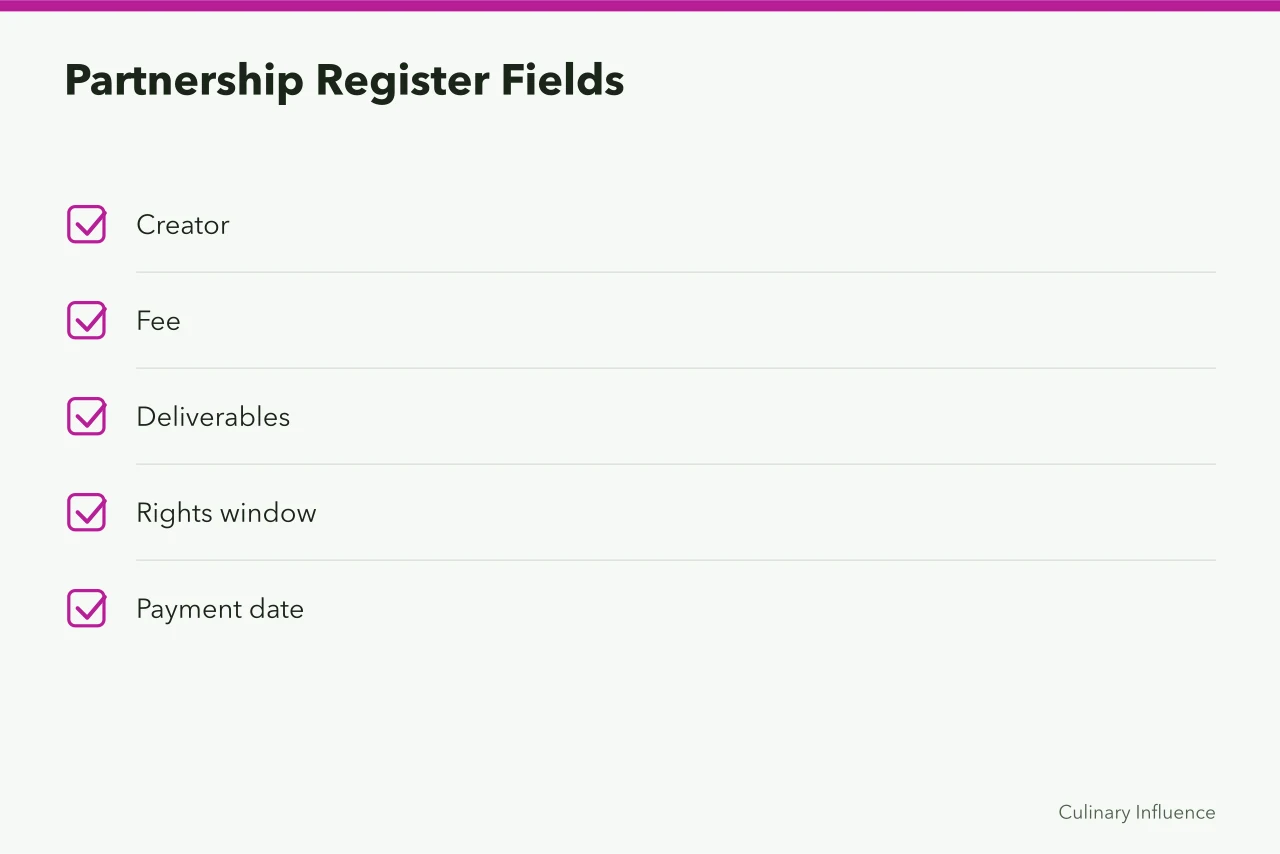
Keep a register of every partnership. Creator, fee, deliverables, rights window and payment date. When a staff member leaves, that register is what keeps the campaigns running.
Read the terms the creator sends back. Creator-side contracts often include clauses on approval timelines and content removal that affect what you can do later.
Payment terms, invoices and late delivery
Agree the payment trigger before the shoot. Standard practice is payment on delivery of the agreed assets, not on the date of posting.
State the terms in the agreement. Thirty days from a valid invoice is common, though smaller creators often expect faster and will price accordingly.
Late delivery needs a written consequence. A reduced fee for missing the agreed window is easier to enforce than a vague expectation of goodwill.
Keep invoices in the same register as the contract. When three campaigns run at once, that paperwork is what stops a double payment or a missed one.
Safety, allergens and a working kitchen
Filming in a working kitchen brings risks that a studio shoot does not. Hot surfaces, knives, moving staff and cleaning chemicals all need managing while a camera is rolling.

The HSE's COSHH guidance explains how to assess substances used in food production, from oven cleaner to flour dust. Walk the shoot through that assessment before anyone films.
Allergens are a legal matter as well as a content one. Creators should not improvise claims about a dish, and any caption naming ingredients needs checking by someone who knows the recipe.
Brief the crew on where they may stand. A camera operator positioned in the path of a service hatch slows the kitchen and creates a hazard.
Data, AI tools and creator matching
More platforms now match restaurants with creators using automated scoring. That is convenient, but it moves personal data between systems and the rules still apply.
The ICO's guidance on artificial intelligence covers the data protection questions raised by AI-driven tools. Read it before connecting a matching service to your booking process.
The same thinking applies to auto-generated captions and scheduling tools. If a tool holds creator contact details, you need a lawful basis for holding them and a retention rule for deleting them.
Write down which systems hold creator data. A short data map is easier to maintain than a reconstruction exercise after a subject access request.
Paid support and platform tools
Organic reach is not a plan. If a partnership includes paid amplification, agree who funds it, who owns the ad account and how long the ads run.
Paid Amplification Terms
- Who funds the spend
- Who owns the ad account
- How long the ads run
- Spend cap in writing
- Who replies to comments
Campaigns can be created and managed in TikTok Ads Manager, which handles campaign set-up, targeting and reporting in one place.
CAP the spend in writing. A boosted post that runs for six weeks can cost more than the creator fee it was meant to support.
Agree who replies to comments on paid posts. An unanswered question about opening hours wastes the money spent on the impression.
Keeping the business running through a campaign
A campaign does not pause the rest of the business. Deliveries still arrive, staff still call in sick and equipment still fails.
The GOV.UK guidance on keeping your business running covers continuity and risk in practical terms. It is worth a look if one campaign now accounts for a noticeable share of weekly covers.
Have a fallback ready. If a creator cancels 48 hours before a shoot, know which dish you will promote instead and who will post it.
Insure the obvious things. Equipment, stock and public liability cover are standard, and a shoot adds people to a site that already carries risk.
The launch review
Seventy-two hours before go-live, run a short review. Confirm the assets are approved, the captions are accurate, the links work and the booking system can take a spike.
Check the offer as well as the content. A sold-out dish, a closed section of the restaurant or a changed opening time will undermine a post that gets everything else right.
A launch review process gives that check a fixed shape, so it does not depend on someone remembering to ask.
Give the review a fixed agenda and keep it to twenty minutes. Anything unresolved at that point becomes a decision for the named approver, not a discussion for the group.
Diary the review when you diary the shoot. Reviews that are not scheduled tend not to happen.
Keep the review on the calendar for every campaign, however small. The habit is what makes the check useful, not the size of the launch.
Measure bookings, not applause
Views are easy to collect and hard to act on. Bookings, covers and average spend per head are the numbers a restaurant can use.
Set the measurement and reporting routine before the first post goes live. Attribution built after the fact is guesswork with a spreadsheet attached.
Tag bookings at the point of reservation. A single question on the booking form is enough, as long as staff ask it consistently.
Compare creators against each other on cost per attributed booking. It is the one figure that stays comparable across different fee levels and audience sizes.
What to do when a post underperforms
Not every post works. Before blaming the creator, check the basics. Was it published at a time when the audience was awake? Did the caption carry a clear reason to book?
Give the content a second life. A strong dish shot that flopped in the feed can work as a paid ad or a story sequence.
Decide in advance what counts as underperformance. Without a threshold, every review becomes a debate about feelings rather than numbers.
If a creator consistently misses agreed deliverables, do not renew. The cost of a partnership is not only the fee, it is the staff time it consumes.
Scaling a partnership programme across sites
Multiple sites need a shared brief template and a shared rights schedule. Site managers can then localise the dishes without rewriting the legal terms.
Centralise payment and reporting, but let each site choose its own creators. Local knowledge beats a national list, particularly outside London.
Set a CAP per site per quarter. A programme that grows faster than the reporting can follow it stops being measurable.
Review the whole programme quarterly. Look at cost per attributed booking by site, and move budget towards the sites that convert.
Worked example: twelve weeks, five creators
The figures below are illustrative for a single-site restaurant in England. They are not a rate card and they are not benchmarks.
Costs:
Twelve-Week Campaign Cost
- Creator fees£2,450
- Food and venue£480
- Staff time£510
- Paid amplification£600
- Contingency£404
Total campaign cost: £4,444.
On the same illustrative basis, the campaign produces 210 attributed bookings at an average spend of £38, which is £7,980 of revenue. Cost per attributed booking is about £21.
Fees are just over half the total. The rest sits in food, labour, paid media and contingency. A campaign that looks affordable on the fee alone can still miss its margin.
Break-even sits at about 117 bookings. If only 90 bookings came in, revenue would be £3,420 against £4,444 of cost, and the partnership would have lost money.
Run the same arithmetic before you sign anything. If break-even needs 117 bookings and the venue only turns 60 covers on a Friday, the campaign has to reach well beyond the usual crowd.
Common questions
How long should a food creator partnership run?
For a menu launch, most of the useful results land in a four to six week window. Longer runs suit always-on content or a venue with a rolling programme. Anything past twelve weeks needs a scheduled review point.
Who should approve the final content?
One named person, usually whoever owns the brand voice. Give the kitchen a fixed deadline for checking dish claims rather than an open invitation to comment. A single approver keeps the launch date honest.
What should we pay a food creator?
There is no single UK rate. Fees move with audience, deliverable count, exclusivity and whether the content is licensed for paid use. Price the rights separately, because a £350 post and a £350 post with six months of paid usage are not the same product.
Do we need a written agreement?
Yes, even for a small collaboration. A short document covering deliverables, dates, fee and rights is enough. Add approval and payment terms to the same page, and it will remove most of the arguments that stall a launch.
In this guide
- Food creators: the partnership workflow explainedA practical workflow for food creators and restaurant teams, covering the partnership deal, approvals, publication, payment and filing.
- Food influencers: a restaurant partnership checklistA practical food influencers checklist for restaurant partnerships, covering sign-off, asset standards, UK ad disclosure, usage rights and service cover.
- When to add food creator partnerships team rolesA practical listicle on when restaurant groups should add food creator partnerships team roles, plus a roles checklist and compliance context for England.
- Service standards set the tone or paperwork sets the paceService standards for food creator partnerships: how English restaurant teams set scope, owners, timings, escalation and data rules in a single page.
- Food creators: what a launch review can assessFood creators: what a launch review covers, its limits, and how to separate vendor claims, independent evidence and reviewer judgement.