Foundations
Paid reach or earned trust, foundations for food creator partnerships
How England's restaurant and food creator partnerships work in practice, from briefs and lawful data use to fees, disclosure rules and measuring returns.
What to take away
- A Manchester restaurant owner opening a second site is fielding enquiries that mix paid posts with requests for a free meal, and those two need different answers.
- Partnerships fall into four common shapes, paid posts, gifted visits, affiliate codes and menu collaborations, and each carries its own tax and disclosure duties.
- Rates are quoted per deliverable, so usage rights, exclusivity and extra shoot days each need a separate budget line.
- Data protection law applies as soon as a venue keeps a list of creator contacts for outreach.
- Covers, bookings and repeat visits decide whether a partnership worked, not follower counts.
Defining a creator partnership
A creator partnership is an arrangement, paid or in kind, where someone with an audience produces food or drink content and the business gets agreed rights in return.
Partnership types compared
Gifted
- Payment
- No charge
- Deliverables
- Optional post
- Approval
- None
- Rights
- Limited
- Disclosure
- Ad label
Paid
- Payment
- Fee
- Deliverables
- Written, deadline
- Approval
- Final cut
- Rights
- Reuse footage
- Disclosure
- Ad label
Affiliate
- Payment
- Tracked orders
- Deliverables
- Bookings
- Approval
- None
- Rights
- Commission
- Disclosure
- Ad label
Most disputes trace back to a missing sentence rather than a missing payment, so settle rights before anything is filmed.
Gifted visits sit at the simple end. A creator eats without charge and decides afterwards whether to publish. No rule obliges a positive review, and a brief that demands one is a weak brief.
Paid work adds a fee, a deadline and written deliverables. The venue usually wants sight of the final cut and permission to reuse the footage on its own channels.
Affiliate deals pay on tracked orders or bookings. Menu collaborations put a creator's name on a dish for a fixed run. Ambassador arrangements last months and often include exclusivity.
Disclosure applies throughout. The Advertising Standards Authority's CAP Code requires marketing communications to be obviously identifiable, which in practice means a clear ad label early in the post.
A partnership is not the same as a review. Reviewers keep editorial control, and paying for coverage that looks like a review creates problems for both sides.
Who buys creator content
Demand comes from more than independent restaurants. Multi-site groups use creators to launch a new branch, and delivery operators use them to push a specific menu.
Supermarkets and drinks brands commission recipe content around seasonal ranges. Agencies buy on behalf of those clients and often control the brief, the budget and the approval chain.
Hotels with restaurants, food halls and event venues also appear regularly. Their buying cycle tends to be longer because marketing, operations and sometimes a landlord all have a view.
Pub operators and franchise groups are the fastest-growing buyer type in the segment, because one decision covers dozens of sites.
Small venues rarely appear as repeat buyers. A single site may run two or three campaigns a year, which makes them valuable for creators but hard to build a business on.
Demand signals to watch
Track how many enquiries each month arrive with a named fee, a format and a date. Three or more from different creators points to a working market.
Check audience location before replying. A creator who shares a location breakdown showing most followers inside the venue's catchment is a usable match. One who will not share it is not.
The pattern matters more than any single message. New openings, seasonal menu changes and delivery launches all pull creator interest towards a venue for a few weeks. The demand signals behind food creator partnerships sets out how to separate a genuine wave from a noisy fortnight.
Time how quickly a paid brief is taken up. A slot filled inside a week suggests spare creator capacity; one that takes a month suggests the opposite.
Watch who approaches whom. When creators contact a venue rather than the reverse, the venue usually has pricing power.
England market size and scope
The Office for National Statistics publishes tourism industry data covering food and beverage service activities, accommodation and visitor attractions. It is the closest official read on the sector that buys creator content.
No single dataset counts creator partnerships. Venues sit inside hospitality, creators sit inside a wider freelance economy, and the money often moves as marketing spend rather than media buying.
That gap explains why quoted market figures vary so widely. Anyone claiming a precise national total is usually adding up something else.
Work the buyer pool from the bottom up instead. Say an English city has 1,000 food and drink venues. If between 5% and 10% of them buy one paid creator campaign a year at an illustrative £500, that city accounts for £25,000 to £50,000 of creator spend. That is an illustrative model, not an official estimate.
For a practical estimate of the buyer pool, sizing the England market for food creator partnerships shows how to build one without counting the same restaurant group twice.
Food hygiene enforcement sits with local authorities in England, while Food Standards Scotland covers Scotland. That split matters when a brief involves kitchens, storage or allergen claims.
Paid reach or earned trust
Paid reach buys certainty. A venue can specify the format, approve the wording and choose the publication date, which suits a launch with a fixed opening night.
Earned trust is slower and cannot be scheduled. A creator who genuinely likes a dish tends to describe it in their own words, and audiences are quick to spot the difference.
Most operators end up running both, using paid content for a fixed campaign and gifting for background coverage through the year. The two need separate budgets and separate success measures.
Content that is paid for needs an ad label even when the creator would have posted anyway.
Choosing a working model
The model should follow the objective. A new site wants covers in its first fortnight, a delivery brand wants tracked orders, and an established restaurant may want reach into a neighbourhood it does not yet serve.
Cost sits alongside that. A one-off paid post is cheap to test but produces little reusable material. A longer ambassador deal costs more and gives the venue assets it can run for months.
The food creator partnership business models compared in our foundations series cover retainer, revenue share and hybrid arrangements. That helps when a creator proposes something outside the usual brief.
Working with agencies
Not every venue briefs creators directly. Agencies hold the relationships, negotiate the fee and handle the paperwork, which suits groups without a marketing team.
Check membership of a trade body such as the Institute of Practitioners in Advertising (IPA), and use platform tools such as TikTok's Creator Marketplace to view creator stats before briefing.
That convenience has a price. Agency margin sits on top of the creator fee, and the venue usually cannot see how the total was split.
Ask who holds the contract with the creator. If the agency does, the venue has fewer remedies when a post is late or off-brief.
Small operators often do better negotiating directly for the first few campaigns. Once the process is understood, an agency can save time rather than money.
Formats and briefs
Reels and short vertical video dominate, followed by carousels of dishes and long-form reviews. Live cooking sessions suit venues with a strong chef presence.
A usable brief covers the dish, the location, the date and the shoot window. It should also state what the creator cannot show, such as staff faces, supplier packaging or a competitor's branding in shot.
Approval terms need care. Demanding script approval on a platform built on personality rarely improves the content, and it slows everything down.
Ask for raw files if the venue plans to edit later. That request belongs in the written terms, not in a message the night before.
Written briefs also protect the creator. A clear scope makes it obvious when a venue asks for work that was never priced.
Seasonality and timing
Hospitality demand is seasonal and so is creator attention. Christmas menus and summer terraces attract far more pitches than a wet Tuesday in February.
Book paid work six to eight weeks ahead of a key trading period. Creators with established audiences are rarely free on a week's notice.
Quiet months are the opportunity. A restaurant that runs creator content in January or September often pays less and gets a more considered post.
Avoid launching a campaign during a major food event unless the venue is part of it. The feed fills up and the content disappears quickly.
Handling creator data lawfully
A spreadsheet of creator contacts is personal data. So is a direct message list, a CRM segment or an agency brief with names and handles attached.
The Information Commissioner's Office explains choosing a lawful basis for direct marketing, and the same reasoning covers outreach to creators. Pick the basis before the first message, not after.
Consent is one route. Legitimate interests can work for business-to-business outreach where a venue can show the balancing test was done and offers a clear opt-out.
Keep records short and honest. Note where each contact came from, why the venue holds it and when it will be deleted.
Setting up step by step
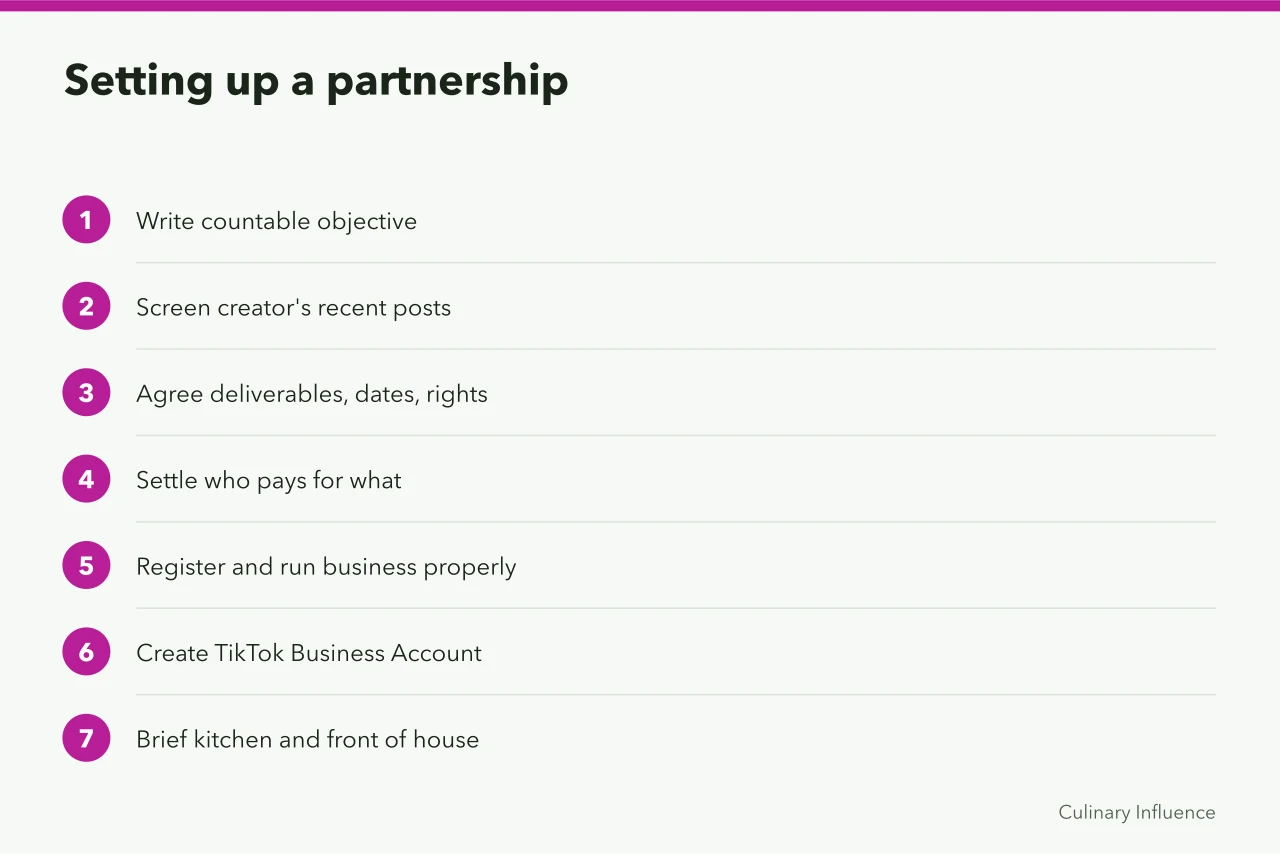
- Write the objective as something countable, such as bookings in the first fortnight.
- Screen the creator's recent posts for audience location and engagement quality.
- Agree deliverables, dates, usage rights and exclusivity in writing before the visit.
- Settle who pays for the meal, travel and any props or ingredients.
- Register and run the business side properly, using the official business and self-employed guidance for tax, records and regulation.
- Create a TikTok Business Account if the plan includes paid promotion of the content.
- Brief the kitchen and front of house on timings, portion sizes and photography.
- Review the numbers within 14 days and pay on the agreed terms.
A one-page brief prevents most disputes. Put the deliverable count, the deadline, the fee and the approval process on it.
Expect one round of revisions on paid work. Build that into the timeline rather than treating it as a favour.
Fees and usage rights
Fees vary with scope, not just audience size. For example, a single-site restaurant in Leeds might pay £250 for one reel and three stories. Treat that as an illustrative figure, not a market rate.
A five-image carousel might sit at £150 to £200, and a three-month ambassador retainer covering four posts a month at £1,500 to £2,500. Both are illustrative.
Illustrative fee and rights
- £250one reel and three stories
- 12 monthswebsite, ads, menus licence
- 6 monthsexclusivity within a mile
Usage rights are the most commonly missed line. If the venue wants the footage on its website, in paid ads and on printed menus for a year, that is a licence. Licences are priced separately from the post itself.
Exclusivity costs more again. Asking a creator to avoid rival venues within a mile for six months restricts their income, and the fee should reflect that.
The commercial opportunities in food creator partnerships covers sponsorship, events and co-branded products. Those sit outside the standard post-and-pay arrangement and are usually negotiated separately.
Contracts and exit terms
A short agreement beats a long one that nobody reads. One page covering scope, fee, dates and rights is usually enough for a single campaign.
Include a termination clause. If a creator's audience turns out to be in the wrong city, the venue needs a way out before the remaining posts are published.
State who owns the footage and for how long. Silence here causes more arguments than late payment does.
Payment terms belong in the contract too. Thirty days from a valid invoice is common, and a date certain avoids the chasing emails; creators on tight cash flow price late payment into the next quote.
Budget planning
Build the budget from deliverables rather than from a follower count. Ten posts at £250 costs £2,500 before any rights, travel or production.
Add a contingency. Reshoots, weather and a closed kitchen on the agreed day all happen, and rebooking costs money.
Measuring what matters
Views are a poor proxy for a good partnership. A venue needs to know whether people turned up, ordered the dish and came back.
Practical measures include bookings attributed to a named code, covers on the nights a post went live, and the share of first-time guests who return within three months.
Set the baseline before the campaign. Without a pre-campaign figure, any lift is guesswork, and the finance director will say so.
Our guide to measurement and reporting for food creator partnerships explains how to build a simple dashboard that survives scrutiny. Keep it to a handful of numbers.
Health, safety and claims
Kitchen content carries real risk. Filming during service, hot pans near a phone and creators standing in walkways all create hazards that a normal shift does not have.
The Health and Safety Executive publishes health and safety statistics on reported workplace injury and ill health. Use that evidence base if a brief or a pitch makes safety claims.
Allergen information still has to reach the guest. A creator reading a menu on camera is not a substitute for the venue's own allergen process.
Food safety training records are worth keeping current, particularly when a contractor is in the kitchen with equipment.
Risks and complaints
The obvious risk is a post that lands badly. A negative review is not a breach of contract, and a contract that punishes one is unlikely to be signed by anyone with an audience.
Brand safety cuts both ways. Venues should check a creator's recent output, and creators should check who else a restaurant group works with.
Complaints about undisclosed advertising go to the Advertising Standards Authority. Most are resolved by adding a label, which is cheaper than a ruling.
Keep the paper trail. Briefs, invoices, approval messages and published links are the record if a dispute reaches a platform or a regulator.
Common questions
Do paid restaurant posts need an ad label?
Yes. Payment, free food or any other incentive makes the content a marketing communication, and the CAP Code requires it to be obviously identifiable. A clear label near the start of the post is the usual route.
Is a gifted meal a payment?
For disclosure purposes it counts as an incentive, so the post still needs labelling. For tax, the position depends on the arrangement and the creator's status, which is why written terms help both sides.
How much should a restaurant budget for creator content?
There is no published rate card. Budget per deliverable, then add usage rights, exclusivity and production costs. Many venues start with a small paid test alongside gifting before committing to a retainer.
What should a partnership contract include?
Deliverables, dates, fee, payment terms, usage licence, exclusivity, approval process and disclosure obligations. Add an exit clause so either side can stop if the content or the venue misreads the audience.
In this guide
- How to size food influencers' partnerships in EnglandA guide to sizing food influencers' paid and gifted partnerships with restaurants and brands in England, using named data sources and clear assumptions.
- Check these food creator partnerships demand signals before you budgetDemand signals that justify food creator partnerships spend, from ONS retail data to Defra food statistics, plus a test-budget rule for England operators.
- What the food creator partnerships business model choice means for marginsHow flat fees, revenue share, retainers and gifting compare on cash flow, risk, control and disclosure in England's food creator partnerships.
- Starting paid partnerships with food influencersA starting checklist for UK restaurants working with food influencers, covering demand, content rights, legal duties, measurement and a scoring rubric.
- Food influencers: commercial deals beyond paid postsFood influencers can work with restaurants beyond sponsored posts through dishes, residencies, licensing and revenue shares, with clear rights and compliance.